Two Ways to Stop Someone
Ran into both sides of the same interface pattern in one day, which is the only reason the comparison is worth writing down.
The first is ours, described in the entry above: a dish that cannot be added to the cart until the customer picks a heat level. A blocking dialogue, deliberately in the way. It costs a click and it tells you exactly what the click is for.
The second happened to me. I registered on a community for founders, finished a piece written specifically for that audience, opened the posting page and got a red banner: You can't create posts yet. Nothing else. No reason, no steps, no idea whether this lifts in an hour, in a week, or never. Their help pages say nothing about it either. As it happens comments are open, and that is almost certainly the way through, but no part of the screen says so. I found it by poking at the page.
Both screens block an action. Only one of them carries the information needed to get past it, and that is the whole difference. A rule can be satisfied. A wall can only be walked away from, and most people walk.
A third specimen turned up the same evening, and it is the purest of them. A different platform, a login page, and this:
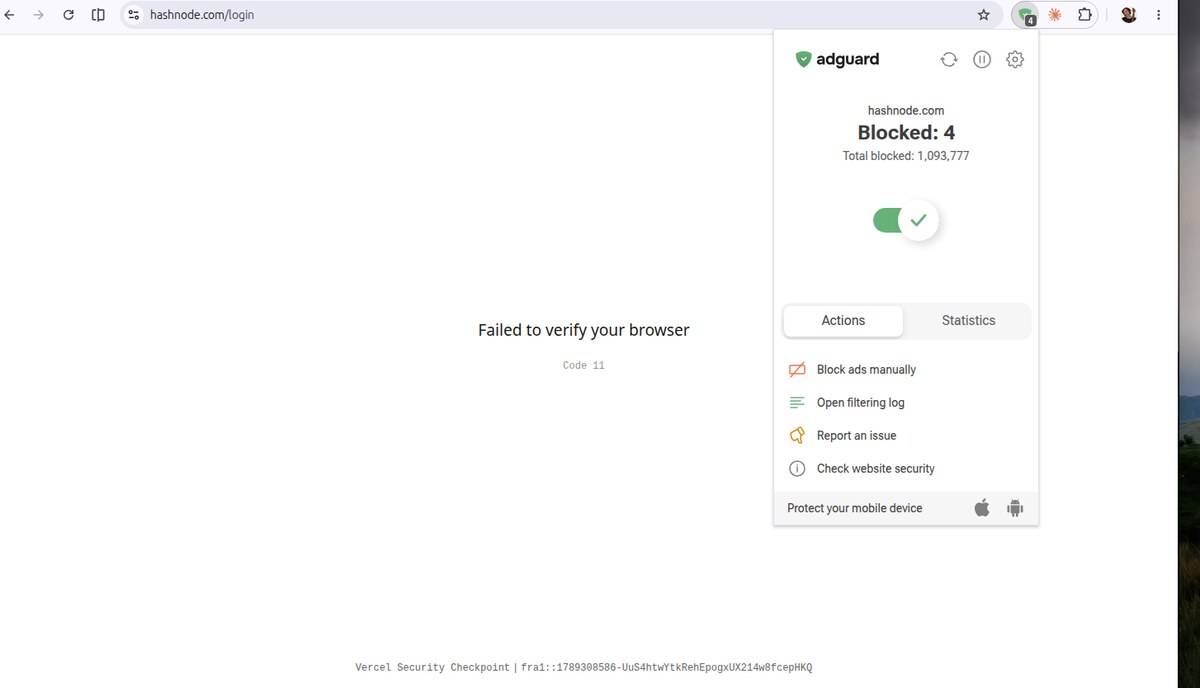
Here not even the reason survives. A code number addressed to whoever reads the logs, shown to the person who cannot. The information needed to get through exists: allow this domain in your blocker, or try a different network. None of it is on the screen. I found the likely cause by reading the small print at the bottom and the blocker's own counter.
The arithmetic is worse for the platform than for me. I had already paid the price they care about, which is the registration, and they still did not get the article. A single sentence under that banner would have cost them nothing: comment on a few discussions and posting opens up. Same pixels, same screen, no development. Instead the reason lives in someone's head, the user gets a fact with no path, and everyone loses something.
The gate itself is fair enough. Their feed carries obvious spam, so somebody clearly poured junk into the place and a barrier went up in response. Barriers are defensible. Silence about them is not, and the two are separable: what stops abuse is the gate, not the failure to explain it.
Self-audit, since it would be cheap to write this about someone else only. This very site spent the morning doing the same thing in its own way. A tag cloud that looked clickable and did nothing when clicked. A section inviting the world to reading groups that had never existed. Both told the visitor something that was not true about what they could do next. Different failure, same disrespect for the person in front of the screen.